Introduction to The Earth in the Solar System
The Earth is a part of a vast universe filled with millions of stars, planets, and other celestial bodies. In this chapter, we learn about the Earth, the Solar System, stars, planets, and the universe in a simple and easy way.
Understanding this chapter helps students know where we live in the universe and how different celestial bodies exist and move in space.
Click On The Name To Go To A Specific Topic:
What is the Universe?
The universe is the largest space that includes everything that exists:
- Stars
- Planets
- Galaxies
- Moon
- Asteroids
It is so large that scientists are still exploring it.
What is a Star?
A star is a huge ball of hot gases that gives off its own light and heat.
The most important star for us is the Sun, because it provides:
- Light
- Heat
- Energy for life on Earth
At night, we can see many stars shining in the sky.
What is a Planet?
A planet is a celestial body that:
- Does not have its own light
- Revolves around a star (like the Sun)
- Is spherical in shape
The Earth is a planet because it revolves around the Sun.
The Solar System
The Solar System consists of:
- The Sun (center)
- Eight planets
- Their moons (satellites)
- Asteroids
- Comets
All planets move around the Sun in fixed paths called orbits.
The Sun – The Center of the Solar System
The Sun is:
- The center of the Solar System
- A huge star made of hot gases
- The main source of energy for all planets
Without the Sun, life on Earth would not exist.
Planets of the Solar System
There are eight planets in our Solar System:
- Mercury
- Venus
- Earth
- Mars
- Jupiter
- Saturn
- Uranus
- Neptune
Earth – Our Home Planet
The Earth is the third planet from the Sun.
It is special because:
- It has air (atmosphere)
- It has water
- It supports life
That is why Earth is called the “Unique Planet”.
The Moon – Earth’s Satellite
The Moon is the natural satellite of the Earth.
Important facts:
- It does not have its own light
- It reflects sunlight
- It takes about 27 days to revolve around the Earth
What is a Satellite?
A satellite is a body that moves around a planet.
There are two types:
1. Natural Satellite
Example: Moon
2. Artificial Satellite
Made by humans for:
- Communication
- Weather forecasting
- Research
Asteroids
Asteroids are small rocky bodies that move around the Sun.
They are found between Mars and Jupiter in a region called the Asteroid Belt.
Comets
Comets are celestial objects made of:
- Ice
- Dust
- Gases
They have a bright tail that appears when they come close to the Sun.
Constellations
Constellations are groups of stars forming recognizable shapes.
Example:
- Ursa Major (Big Dipper)
- Orion
They help in navigation and identifying stars.
Important Terms
Galaxy
A galaxy is a large system of stars.
Example: The Milky Way Galaxy, where Earth is located.
Orbit
The fixed path in which planets move around the Sun.
Celestial Bodies
All objects in space, like stars, planets, and moons.
Why is Earth Unique?
Earth is unique because:
- It has oxygen for breathing
- It has water for life
- It has a suitable temperature
No other known planet supports life like Earth.
Daily Life Connection
We are directly connected to the Solar System:
- Day and night occur due to Earth’s rotation
- Seasons change due to Earth’s revolution
- The Moon affects tides
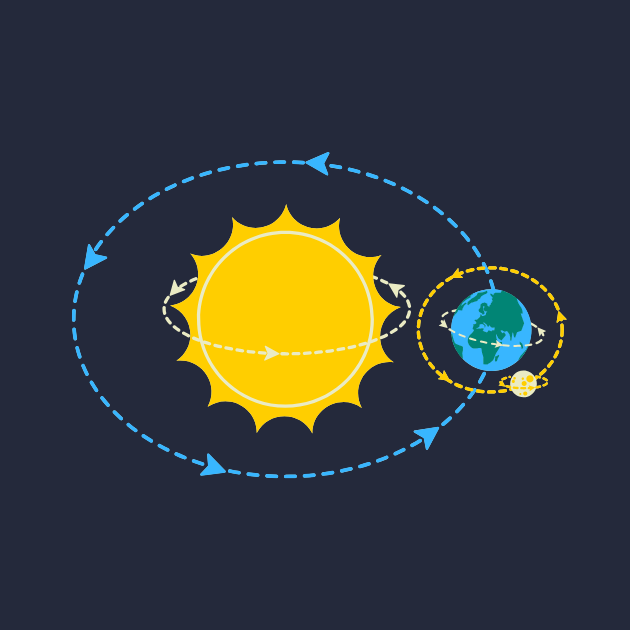
We are directly connected to the Solar System:
The Earth is a small part of a vast universe, yet it is the only known planet that supports life. By understanding the Solar System, students learn about space, planets, and our place in the universe.
This chapter builds curiosity and interest in astronomy and geography, helping students explore the world beyond Earth.
Interesting Facts
1. Facts About the Sun:
- The Sun is so big that about 1.3 million Earths can fit inside it.
- It is made mostly of hydrogen and helium gases.
- The Sun’s light takes about 8 minutes to reach Earth.
- It is the main source of energy for all planets.
2. Facts About the Earth:
- Earth is the only known planet with life.
- About 71% of Earth is covered with water.
- Earth is called the “Blue Planet” because of water.
- It takes 24 hours for Earth to complete one rotation (day and night).
- It takes 365 days to complete one revolution (one year).
3. Facts About the Moon:
- The Moon is Earth’s only natural satellite.
- It has no air and no water.
- The Moon’s gravity is weaker than Earth’s.
- Humans first landed on the Moon in 1969.
4. Facts About Planets:
- Mercury is the closest planet to the Sun.
- Venus is the hottest planet.
- Jupiter is the largest planet in the Solar System.
- Saturn has beautiful rings around it.
- Neptune is the farthest planet from the Sun.
5. Facts About the Solar System:
- The Solar System formed about 4.6 billion years ago.
- All planets move in fixed paths called orbits.
- The Sun is at the center of the Solar System.
- The Solar System is part of the Milky Way Galaxy.
6. Facts About Stars and Galaxies:
- Stars appear small because they are very far away.
- There are billions of stars in a galaxy.
- The Milky Way galaxy contains our Solar System.
7. Facts About Comets and Asteroids:
- Comets are often called “dirty snowballs”.
- They develop a bright tail near the Sun.
- Asteroids are mostly found in the Asteroid Belt.
Fun & Interesting Facts for Students
- You weigh less on the Moon than on Earth.
- There is no sound in space because there is no air.
- A day on Venus is longer than a year on Venus!
- Jupiter has a storm called the Great Red Spot that has lasted for hundreds of years.
Activity (Exercise):
Coming Soon…
Quiz:
Coming Soon…
Supplementary Materials:
Provide downloadable materials for learners to review:
- – PDF Guide: “Coming Soon”
- – Cheat Sheet: “Coming Soon”
- – Video Source: “JNG ACADEMY“
- – Articles: “Blog Page“